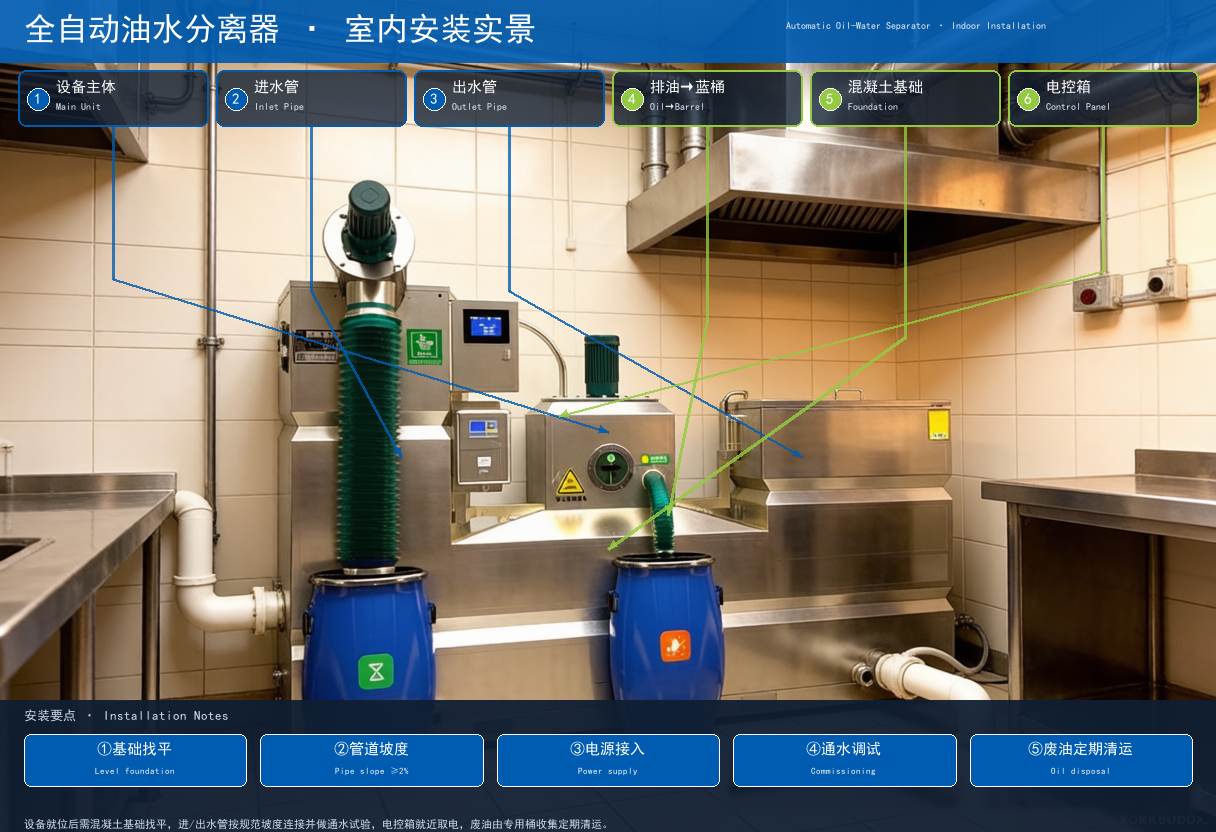
应用范围 / Application
全自动油水分离器广泛应用于餐饮、工业、市政等多个领域。在餐饮与商业场所(如酒店、餐厅、商场、学校食堂等)用于处理含动植物油脂的厨房废水,具备高效分离、自动排油、防异味等功能;在工业与制造业(如机械加工、石油化工、食品加工等)用于处理含矿物油、乳化油等成分复杂的工业含油废水,对分离精度和抗冲击性要求更高,常作为废水处理的预处理环节。设备根据场景不同,主要分为基于重力/气浮原理的餐饮型和基于旋流/聚结原理的工业型。
Automatic oil-water separators are widely used in catering, industrial, municipal, and other fields. In catering and commercial venues (such as hotels, restaurants, shopping malls, and school cafeterias), they are used to treat kitchen wastewater containing animal and vegetable oils and fats, featuring efficient separation, automatic oil discharge, and odor prevention. In industrial and manufacturing sectors (such as machining, petrochemicals, and food processing), they are used to treat complex industrial oily wastewater containing mineral oils and emulsified oils, with higher requirements for separation precision and impact resistance, often serving as a pretreatment step in wastewater treatment systems. Depending on the application scenario, the equipment is mainly divided into catering-type models based on gravity/flotation principles and industrial-type models based on cyclone/coalescence principles.
产品特点 / Product Features
自动刮油与排油,全程无需人工干预
Automatic oil scraping and discharge without manual intervention
高效气浮分离,对乳化油滴去除效果好
High-efficiency air flotation separation, effective on emulsified oil droplets
可选自动加热系统,防止低温油脂凝固
Optional intelligent heating to prevent oil solidification at low temperatures
配置 PLC 控制系统,实现全自动运行
PLC control system for fully automatic operation
结构紧凑、抗压抗冲击,可适应地埋等多种安装环境
Compact structure with high compression and impact resistance, suitable for underground burial
处理后的出水含油量可降至很低,满足国家排放标准
Effluent oil content can be reduced to very low levels, meeting national discharge standards
工艺流程 / Process Flow
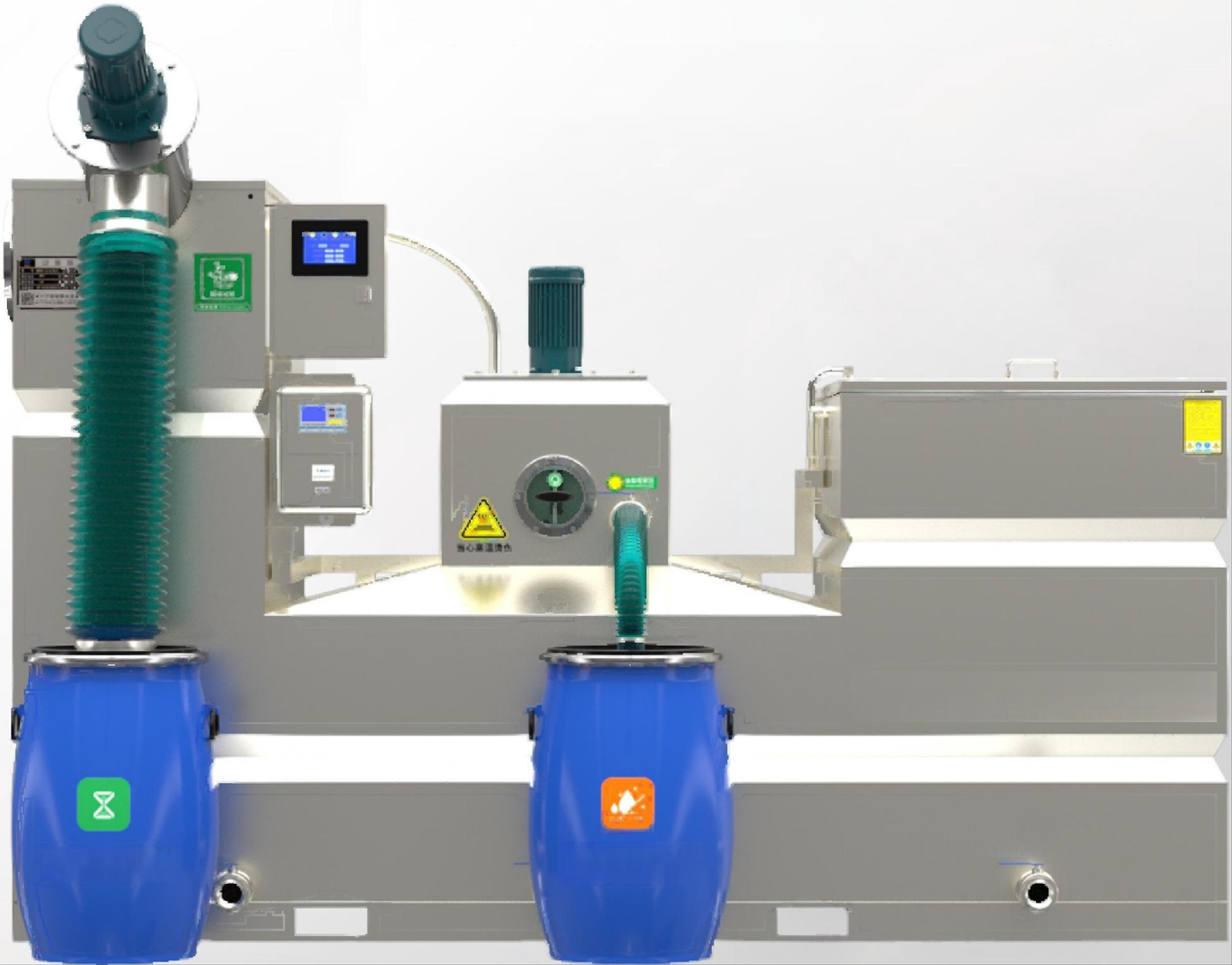
该设备采用“螺旋压榨固液分离 + 重力/加热油水分离”工艺。污水经螺旋提升机截留残渣并压榨脱水排入固废桶;滤液进入加热腔体降低粘度、促进破乳,静置后通过自动刮油机构将浮油刮入集油桶;达标清水从底部排放。全过程由 PLC 智能控制,实现渣、油、水三相全自动分类收集。
This equipment adopts a "spiral press solid-liquid separation + gravity/heating oil-water separation" process. Wastewater passes through a spiral elevator to intercept and dewater residues, which are discharged into a solid waste tank. The filtrate enters a heating chamber to reduce viscosity and promote demulsification. After settling, the floating oil is automatically scraped into an oil collection tank, while the treated clean water is discharged from the bottom. The entire operation is controlled by a PLC system, achieving fully automatic three-phase separation of solids, oil, and water.